Workmen employed at the Harpers Ferry Armory strike for higher wages. Armorers also petition the government to re-establish civil superintendence, calling the current military superintendence "revolting to freemen".

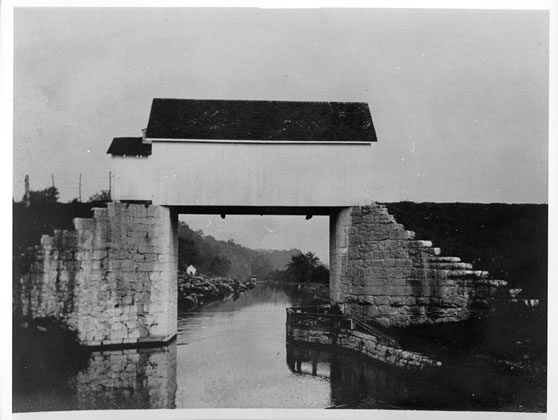
Complete armory renovations were drawn in 1844. These renovations plans included the addition of seven workshops, the installation of 121 new machines, and a canal enlargement.

The Shepherdstown Register reports that a breach at Dam No. 4 is almost closed, with over 100 hands working day and night to close it. The first crib being put in on Tuesday morning (June 22), two more were expected to be in place by the following week. The article reports that both dams should be completed by early summer, and that loaded boats can now pass through the tunnel.

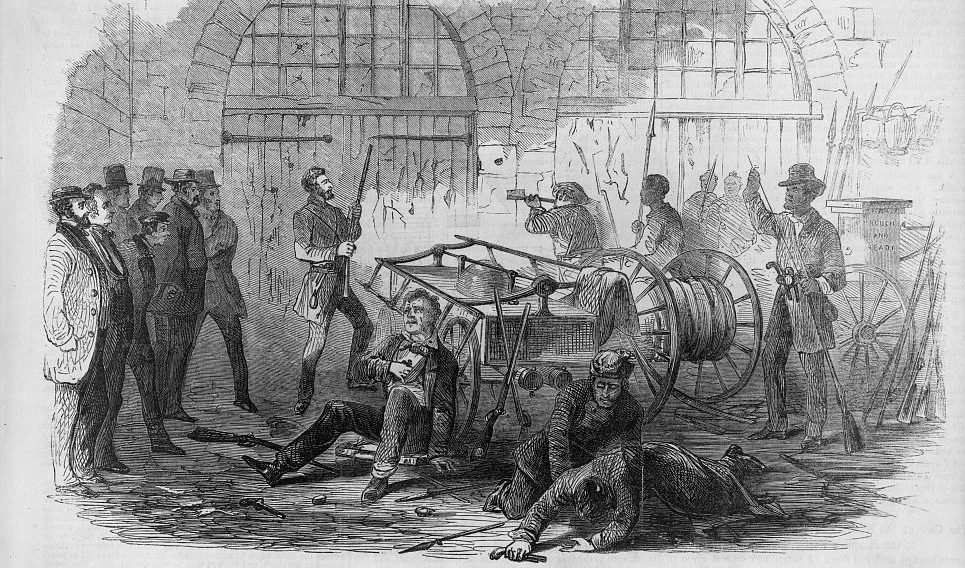
John Brown and 22 men attack the Federal Arsenal at Harpers Ferry to seize both ammunition and arms from the facility. He planned to arm slaves in the region in order to start a large scale southern slave revolt. Receiving little resistance from an unsuspecting Harpers Ferry, he quickly gained control of the armory, arsenal, and engine house, and taking several hostages consisting of prominent citizens and slaves. Brown sent men into the surrounding areas to arm the slaves, believing that the slaves would support his cause and come to his aid -- soon, Brown was surrounded by Marines under the command of Robert E. Lee and J. E. B. Stuart. The soliders stormed the engine house where Brown and his men were taking refuge, killing eight of Brown's men and two of his sons.

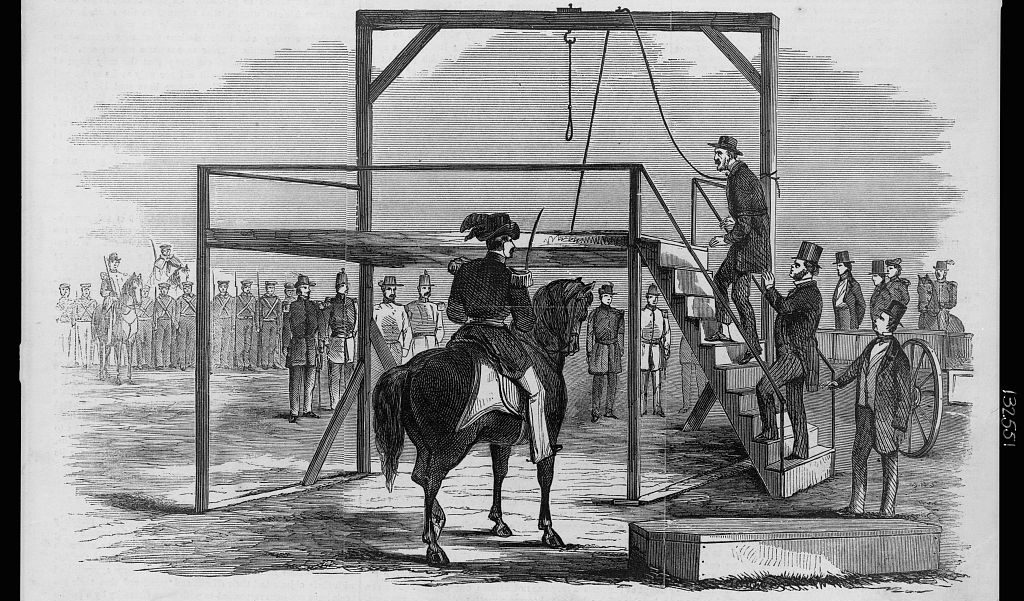
John Brown was driven to his execution site in a wagon seated atop his casket. The execution site was a field which was located along present day Samuel Street in Charles Town. Once he had arrived, Brown was surrounded by an extremely strong military presence, troops and Corps of Cadets from the Virginia Military Institute (VMI), in order to ward off another uprising by Brown's men. Francis Smith, superintendent of VMI, was put in charge of the actual execution on orders from the Governor of Virginia. Brown continued to have a pulse for 35 minutes after he was hung.
Interestingly enough, Major Thomas Jackson was in command of the artillery from VMI at the execution of John Brown. In only a short period of time, Major Jackson would achieve the nickname "Stonewall" and become famous throughout history.

The movement to secede from the Union was ratified, however the majority of Western Counties (supposedly) opposed it's ratification. This was not the case with Jefferson County, nor Berkeley County, where vote tallies appear to have been botched. In fact, original maps show Jefferson and Berkeley Counties remaining as part of Virginia. Historical evidence proves that the two counties resident's actually were in favor of succession, and sympathies still lie with South today.
The Ordinance of Secession is online at the Library of Virginia. The original ordinance was inscribed on parchment and signed by 92 convention members. Later during the second and third conventions, 142 members of the convention signed a ceremonial parchment of the ordinance.

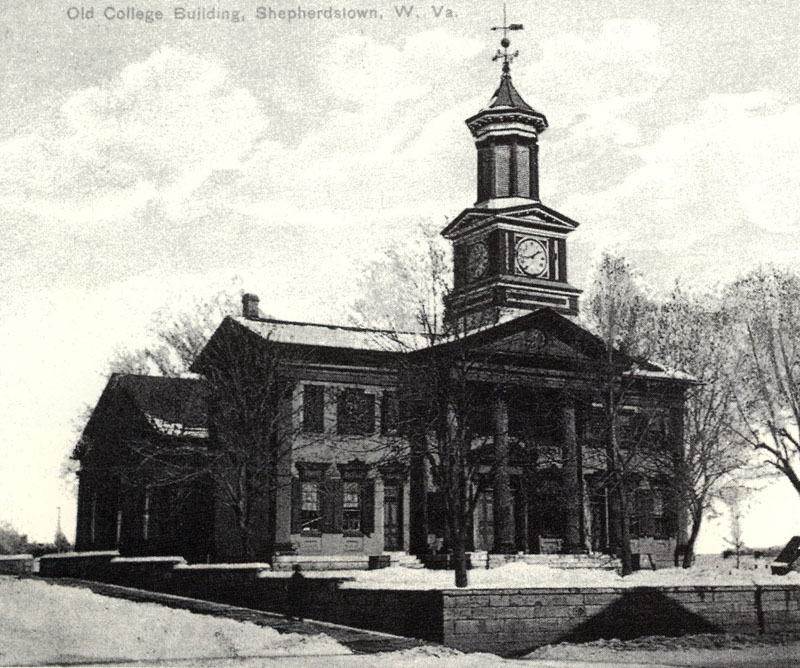
In February of 1865, the courthouse was transferred from Charles Town to Shepherdstown. The courthouse at Shepherdstown was housed in the building which is now McMurran Hall at Shepherd University. The building was originally built by Rezin Shepherd for use as a town hall and was used as a hospital during the civil war Battle of Antietam. Additions were added on either side of the main portion of the building to create offices of the courts.

A part of the old armory's facilities in Harpers Ferry were transformed into Storer College, a institution for the education of African Americans.

Late on this Friday evening and early into Saturday, Harpers Ferry was hit with a terrible flood, claiming the loss of many homes, businesses, bridges, and 43 lives. Because the flood water rose so quickly, many residents of Virginius Island became trapped.
We use this timeline to help us understand the events that may have affected or shaped a person's life. Here are some ideas as to how this timeline may help your further your own research: