


Without the Irish, there would be no Catholic congregation in Harpers Ferry. Although St. Peter's is considered a Roman Catholic parish, the church historically took on an overwhelmingly Irish congregation, and tailored its sermons to the very similar, yet slightly different ideology of the Celtic rooted version of traditional Roman Catholicism.
View Guide

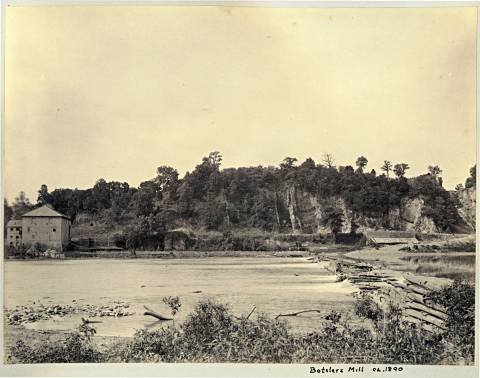


Swiss immigrant Louis Michel traveled along the west bank of the Potomac River searching for land for a Swiss colony. He reported that Indians covered the area.
Near present day Shepherdstown, Presbyterians founded "West" Virginia's very first church at the site of Potomoke, Virginia. However, it should be noted that the Shepherdstown Presbyterian Church refutes this claim, and there is no indisputable evidence either way that I have been able to uncover to date. A small discussion on the Potomoke Church as viewed by Shepherdstown Presbyterian Church (and the history of their own church) can be read here.
Jefferson County, as it sits today, is considered part of Spottsylvania County in Virginia.
The Iriquios Nation surrenders all of their claims to land in the Eastern Panhandle, including present day Jefferson County, by signing the Treaty of Albany with Virginia. This treaty allowed whites to settle both to the south of the Potomac River and between the Blue Ridge and Allegheny Mountains. The Iriquios tribes used the area often as a prime hunting ground. Tuscarora Indians were also present in the area and were admitted to the Iriquios Nation, creating the sixth nation.
The site of present day Shepherdstown, coined New Mecklenburg, is settled and founded by Germans from Pennsylvania. It was probably named after Mecklenburg, a region in northern Germany.
Beginning around 1730, the Virginia government began to encourage people to settle in the valleys of "Western" Virgina. By 1832, the valley is settled mostly by German, Scotch-Irish, and Welsh pioneers.
Israel Friend is deeded land at the mouth of Antietam Creek by the Chiefs of The Five Nations.
Peter Stephens, a trader from Germany, settles on the “point” of present day Harpers Ferry, gaining “squatters rights” to the property. The property is nicknamed “the hole” and “Peter’s hole” due to the low elevation of the area, which is only 247 feet above sea level. Stephens builds a log cabin home. Other pioneers begin to arrive and settle in the surrounding areas as well.
Jefferson County, as it is today, is very briefly considered part of Orange County, Virginia. Previously, the lands were considered a part of Spottsylvania County.
Thomas Shepherd receives a land grant of 222 acres. He selected 50 acres of his original 222 and laid out a town, naming it Mecklenburg, and petitioned the Virginia General Assembly for charter. You can view the original land grant online here.
Jefferson County, as we know it today, is considered part of Frederick County, Virginia.
Thomas Mayburry constructs the first Iron Furnace west of the Blue Ridge Mountains on William Vestal's plantation. The furnace is referred to as Vestal's Bloomery. An interesting discussion on ironworks in Jefferson County, including Vestal's Bloomery, can be read online here. The original contract between Mayburry and Vestal has been transcribed here.
Sixteen year old George Washington surveys land in Western Virginia (now the Eastern Panhandle) for Lord Fairfax. Thomas Fairfax, the 6th Lord Fairfax of Cameron, had arrived in North America around 1736 to protect the claims to land that he had inherited from his mother's family and administered the Northern Neck Proprietary. Read more about Lord Fairfax here.
George Washington, unable to forget about the beauty of the area, purchases his first of many tracts of land in present day Jefferson County, Bullskin Plantation, located near Summit Point -- part of the lands he had just surveyed two years earlier for Lord Fairfax.
Harper, a Quaker colonist who was both a builder and a millwright, secures a patent for 125 acres in "The Hole" at the mouth of the Shenandoah River (present day Harpers Ferry), purchasing Peter Stephen's squatters rights.
Harper was on his way to construct a meeting house for fellow Quakers near present day Winchester when he first traveled through "The Hole", and was attracted to the area because of its ample water supply and strategic location. You can view the original land grant online here.