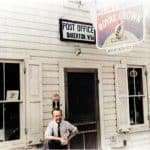

Although a close-knit community existed in Bakerton long before the entrance of the Baker family in 1884, the village of Bakerton was a direct result of the Baker brothers and their Standard Lime and Stone and Washington Building Lime Companies.
The large majority of the villagers were employed by the Washington Building Lime Company. Of those few who weren’t, they were usually dependent on the company in other ways. Thus, both the Baker brothers and the limestone and agricultural industries had a direct effect on the culture of the surrounding village.
This economic dominance did not stunt the growth of other enterprises; in fact, the company’s presence created a steady demand that sustained a variety of local businesses. Bakerton was home to numerous small businesses, including three mercantile stores, a livery, barber, boarding houses, restaurants, blacksmith, opera house, pool hall, bowling alley, saloon, post office, and later, an auto garage and dealership. Scattered throughout the village, these establishments formed the commercial heart of Bakerton. However, commerce was only one layer of the community’s character.
Within the village of Bakerton, distinct sections developed over time, each acquiring their own nicknames based on demographics and physical characteristics. “Little Italy” referred to a cluster of housing predominantly occupied by Italian and Czechoslovakian immigrants. Immediately to the north was “Ten Row”, a row of ten shanties bookended by a well with mostly African American tenants. “Poketown”, named for the numerous poke berries dotting the woodline, was located behind the present-day store and contained a mixture of businesses and housing that was not owned by the company. The “Low Shed” was the name given to the homes surrounding the Virginia Ore Bank.
The company constructed and owned numerous houses that were tenanted by laborers. After 1913, the majority of company homes had electricity, but they did not have running water. In 1928, the Washington Building Lime Company constructed a number of single-family homes in the village, many of which survive today. The rent for these homes was $8 a month. The rent for smaller shanties, like those on Ten Row, was $6.60 per month.
The influx of laborers brought by the Washington Building Lime Company encouraged many local entreprenters to capitalize on the demand for housing. In 1914, Preston Millard, C. D. Carter, and A. G. Rice all subdivided portions of their land and erected rows of dwellings to rent to quarry laborers.
Although the Baker brothers did not directly attempt to influence the culture of the surrounding village of Bakerton, they did attempt to influence the appearance of the village. Most houses and buildings in the village were lime-washed with a special mixture made right in Bakerton. The Washington Building Lime Company provided this lime wash to their employees for their homes free of charge.
For this reason, the vast majority of the houses in Bakerton were very well-kept and bright white in color. According to numerous accounts of newspapers during the period, the village appeared to glow in the sunlight, the facades of homes and buildings being a direct reflection of the industry that sustained them.
Beneath the bright exterior was the possibility of a precarious reality. Unbeknownst to the families who resided in the homes, quarry tunnels ran under many of the homes in the village. The childhood home of George Houser, Jr. was discovered to have been mined underneath the property. A subsequent owner, while drilling a well, inadvertently broke into one of the underlying tunnels. The home next to the community hall had a sink hole in their chicken house from which you could look down and see the mine below.
Charles Knott recounted a story regarding his aunt, Lena Clabaugh, who had just constructed a new home in Bakerton. He stated that her two young sons were playing underneath the shade of a large tree all day into the evening hours. The next morning, the tree had fallen into the quarry. This event caused her such fright that she promptly moved to Harpers Ferry.
Although life in Bakerton came with unique hazards, the life of the men and families who lived in Bakerton wasn’t unlike that of many residents of other close-knit communities. However, making a home in Bakerton did require a few other inconveniences relating to the limeworks.
Although Bakerton is a relatively quiet community today, its historical soundscape was markedly different. Daily blasting operations in the mines typically commenced at 4:00 p.m., and the powerful blasts would reverberate throughout the homes in the entire village. Although villagers were used to this daily occurrence, the intensity of the blasts startled visitors.
The rumble of train engines and whistles were a feature of the village, as were the buzzing of machinery and the sounds of residents and laborers busily moving around the works and village. In addition to the industrious sounds of the village, villagers would have heard the school bell in the Oak Grove Schoolhouse numerous times throughout the day. The sound of industry in the village reflected a community in constant motion, and one in which residents labored long, exhausting shifts. But residents in Bakerton also sought outlets for recreation, competition, and camaraderie.
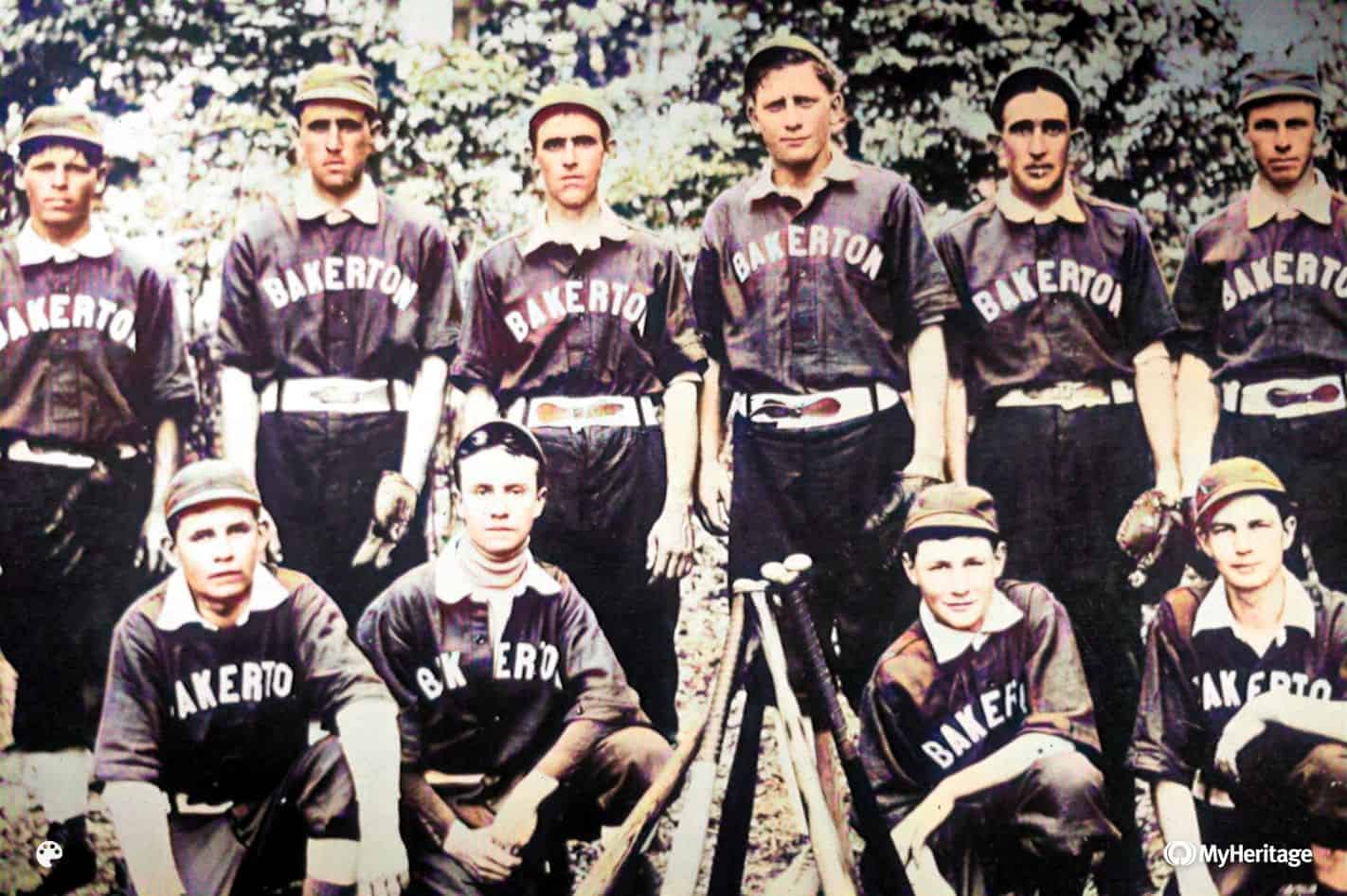
Athletics were a prized pastime in the village, and the villagers were very competitive. Boys in Bakerton were brought up to play ball, and more specifically, baseball.
Bakerton supported two baseball teams, each with its own dedicated field. White laborers played on the field located adjacent to the Oak Grove Schoolhouse, while African American workers played ball on a field situated in a flat over the ridge of the dump north of the Virginia Ore Bank.
Though both teams participated in segregated leagues, laborer Charles Knott recalled that they would occasionally face off in friendly matches. These games, while lively and spirited, were always a source of great enjoyment for the community.
The village of Bakerton also organized competitive games of horse-shoes with surrounding communities. Friendly competition also existed heavily in the agricultural sector, with area newspapers frequently publishing hog and lamb weights and crop yields, challenging local communities and pitting them against one another. During the winter, the ball, bat, and horseshoes were traded for ice skates on the river and the many area ponds.
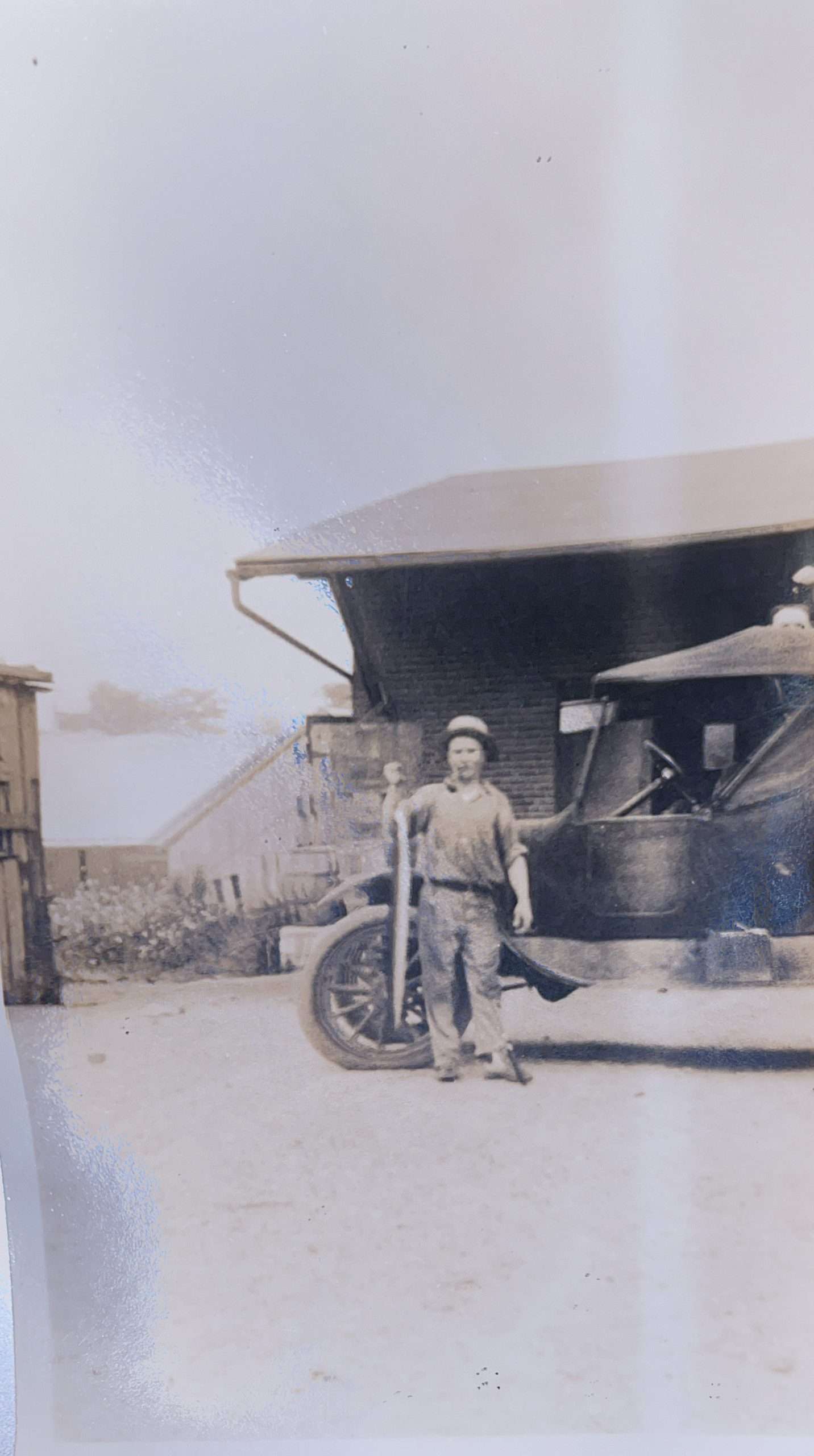
As with most communities in close proximity to waterways, fishing was also a popular pastime. The largest catches, such as the pictured eel, were often sent into fishing contests. This particular eel was over 36" in length with a 10" girth. Although there was no fishing category for eels, Martin was awarded a write-up in the Baltimore Sun for his catch.
In 1898, a “giant” was unearthed at the Virginia Ore Bank, which caused quite a spectacle in the village. The man, who had been wrapped in cloth and buried in a box fastened with hand-made iron nails, was over 7 feet tall with unusually large teeth. Because of the area’s earliest history and importance to Native Americans, it was not uncommon for a resident to accidentally unearth an early human burial.
While exciting discoveries captured the villager’s curiosity, the heart of Bakerton’s community life was centered around celebrations and gatherings. Some of the most well-remembered events were the annual company picnics in Duke’s Woods, at which the Washington Building Lime Company furnished a feast and entertainment for the laborers and villagers. School celebrations, church sponsored suppers, and camp meetings were frequent and well attended.
Despite Bakerton’s industrious nature, its residents exhibited a profound religious devotion. The village boasted at least five churches, including two African American churches. These churches regularly organized oyster suppers and expansive camp meetings, which attracted substantial attendance from the community.
The donations of the Baker family to area churches were numerous and significant. In 1897, the Washington Building Lime Company donated all of the lime needed for the construction of the Lutheran Church at Uvilla. Further, the Washington Building Lime Company generously donated land to the Southern Methodist, the African American Baptist, and the African American Methodist congregations, enabling the construction of their respective churches in the village of Bakerton.
When the company’s operations became uncomfortably close to the Southern Methodist Church, the Washington Building Lime Company purchased the land and church building from the congregation. The company also donated money and material towards the construction of a new building. During a disagreement that led to the division of the Bakerton Methodist Church into two distinct factions, the Washington Building Lime Company acquired property and proceeded to construct the church known as the Bakerton Church of God. At this time, the company also erected a community hall.
The Oak Grove Schoolhouse, constructed before 1880, served as the center of public education for the children in the Bakerton area. The school was a simple two-room building. Each room accommodated four grades, warmed by a pot-bellied stove during the winter months.
Each day, students took turns carrying water from a well to fill a cooler located on the front porch of the building. Renowned as one of the better public schools in the county, Oak Grove owed much of its reputation to the dedication of its teachers, who, with few exceptions, were held in high regard by their students.
This unassuming schoolhouse was known for its delightful closing ceremonies, which were full of both food and entertainment, and were well attended by the majority of the villagers.

A sketch of the Oak Grove Schoolhouse by Jefferson County School Board member Marie Hoage. Notably, the sketch is missing a belfry which the building reportedly included.
In 1921, a three-room schoolhouse was constructed from hollow tiles, which was the first building of this type to be constructed in Jefferson County. The old Oak Grove Schoolhouse was dismantled and used to construct the home of Martin D. Welsh, Sr., while the school’s bell was erected in the belfry at the Bakerton Church of God. The property was then sold to the Washington Building Lime Company. Following the plant’s closure in the 1950s, declining enrollment drew the attention of the Board of Education. Consequently, the Bakerton Elementary school was closed in 1965 and its students transported to Harpers Ferry Graded School by busses.

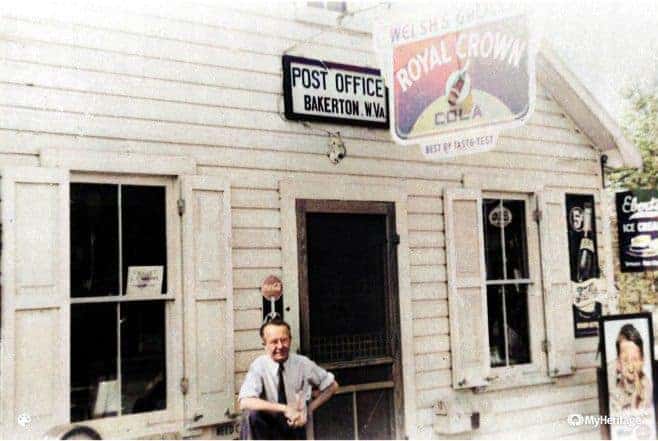
Bakerton was home to numerous businesses, including three mercantile stores, a livery, barber, boarding houses, a restaurant, blacksmith, opera house, pool hall, bowling alley, saloon, post office, and later, an auto garage and dealership.
At least two of the three mercantile stores allowed purchasing on accounts. Both Preston Millard and Martin D. Welsh, the owners of two of the mercantile stores, would zero out their account books at year end, allowing their customers a fresh start for the new year.
As the Washington Building Lime Company rapidly expanded, the village surrounding the works inevitably experienced the complexities of growth, including the challenges of crime. The influx of workers from diverse backgrounds mingling with long-established families created a lively yet occasionally tumultuous atmosphere.
Limited information on crime in the Bakerton locality exists prior to the establishment of the Washington Building Lime Company. However, two sensational murders occurred in 1856. Redman Burke, a resident of Shepherdstown, fatally stabbed Phillip Engle, while James Flanagan was killed by an irate employee less than one year after assuming control of his father’s quarrying operations. Given the area’s industrious nature, it is likely that other criminal activities took place but were perhaps handled quietly by residents.
As Bakerton rapidly grew around the operations of the Washington Building Lime Company and the population of the village significantly increased, the community experienced a rise in criminal activity. Crime in this area appears to be a reflection of the diverse and tightly-knit nature of the village rather than an indication of widespread lawlessness. The close quarters of workers from different backgrounds sometimes led to tensions, but residents generally recalled Bakerton as a pleasant, wonderful place to live, where families thrived and supported one another.
C. D. Carter was constable of Harpers Ferry district and the office was located in Bakerton. The constable was not only responsible for crime related matters within the district, but also escorted the Washington Building Lime Company’s payroll from the Bank of Harpers Ferry. On bank runs, he was always accompanied by two guards to protect the large sums of money.
Members of the Baker family, including those in charge of the Washington Building Lime Company, were staunch temperance advocates, rooted in their deeply Methodist beliefs. While their influence in promoting abstinence from alcohol was felt in their hometown of Buckeystown, it did not extend to Bakerton. Although they encouraged their workers to avoid alcohol and advocated for temperance politically, they refrained from imposing these beliefs on their laborers or the local community.
In the village, alcohol fueled much of the discourse. According to newspaper reports, “shooting scrapes” were such a common occurrence that little mind was paid to them.
One event involved a man named Jack Johnson, who was nearly shot before he disarmed and severely beat the culprit. In 1921, John Proctor was shot by Henry James, leaving him partially blinded by the loss of an eye.
In Shepherdstown, an incident involving an employee of Bakerton’s Virginia Ore Bank led to an arrest. In this particular event, the intoxicated laborer slammed charged dynamite down on the counter of a mercantile store.
In another, an irate employee severely assaulted his superintendent, John McClellan Moore, while at work in the ore bank.

John McClellan Moore, superintendent of the Virginia Ore Bank and victim of an assault by an employee. Here, he sits on his front porch with his wife, Nora Frances Welsh.
During prohibition, illegal liquor poured into the village of Bakerton from across the Potomac. Frog Hollow (near Dargan) and Dargan, Maryland was the origination place of most of this liquor, although stills in the Bakerton area were also numerous. The “Frog Hollow White Lightning” was held in particularly high regard and was bottled in a special bottle with a frog on the label.
Occasionally, altercations would take a deadly turn. In 1903, Tate Morton died after a fight with Henry Taylor over a woman. Both men were employees of the Washington Building Lime Company. In another argument, William Gray shot and killed his friend, Ralph Beckwith, before tying him to weights and dumping his body in an abandoned quarry hole. The man’s body was found weeks later by schoolchildren.
In a horrifying crime, Babe Carter was burned to death in his shanty on Ten Row, the African American section of Bakerton. At the time, a wage strike was underway at the Bakerton quarries, but Carter, a laborer, had chosen not to participate. His charred remains were discovered in a corner of the shanty, where it appeared he had been desperately trying to escape the flames. Authorities suspected that the arson was an act of retaliation by someone angered by Carter’s refusal to join the strike.
Drunken altercations were far more common than theft, but numerous incidents were reported. In 1896, R. D. Houser had one of his horses stolen. The following year, the home of James Flanagan was broken into and numerous family heirlooms and items of value were taken. In 1909, large quantities of brass and copper were stolen from the Washington Building Lime Company and a German Virginia Ore Bank employee fell victim to a highway robbery.
Despite these incidents, Bakerton residents largely remember the village as a welcoming and harmonious place. Crime was often limited to certain hotspots or individuals, and the overall impression is that it was a place where families flourished. Though rough elements of the village existed, they did not overshadow the pride and strong social ties that defined Bakerton for the many families who called it home.
Crime wasn’t the only challenge that plagued the village. Like many company towns, Bakerton and its works were predominantly constructed of wood framing, which posed significant risks due to the presence of large kiln fires. The combination of intense heat and wooden structures created a hazardous environment leading to numerous recorded fires, both large and small, in local newspapers and in the diary of quarryman John M. Welsh. Unless detected early, even small blazes could rapidly engulf the densely packed wooden buildings, resulting in a series of devastating fires that plagued the limeworks and in effect, the village.
In July 1891, fire rapidly spread among the limeworks, claiming the entire new, extensive property. The reported loss was $15,000 and included 8 Baltimore & Ohio Railroad Freight Cars. By the following week, preparations were already underway to begin rebuilding the kilns. In a testament to the spirit of both the laborers and Baker brothers, on November 1 it was reported that “Bakerton is rising, Phoenix-like, from its ashes, and the extensive lime works there will soon be in full operation again.” By December, it was reported by a resident that the entire village and lime works appeared better than before the fire, and that the quarry was already back to running full blast.
On October 11, 1911 at 3 a.m., a large portion of the Washington Building Lime Company in Bakerton was again destroyed by fire. Damages were estimated to be over $20,000. Although the cause of the blaze was never discovered, the fire originated in a pile of cord wood and destroyed large framed structures and a number of kilns. It was stated that although 20 to 30 men were at work at the kilns during the time of the fire, they had all fallen asleep, and by the time they were awoken the fire had made too much headway to extinguish.
In 1917, the company store building caught fire. A clerk, Martin D. Welsh, who tenanted the apartment above the store building, awoke to a smoke-filled room and the sound of crackling fire, with the light of flames peeking through the floorboards. While Martin and his wife narrowly escaped, Mrs. Welsh badly burned her feet on the hot wooden floor. The couple quickly sounded the alarm to workmen and neighbors. Although Martin attempted to save a portion of the merchandise, the fire had already completely engulfed the building. Management of the lime works placed workers on roofs of surrounding buildings with buckets of water to prevent the spread of the fire. The loss of merchandise was estimated at $15,000.
With such close quarters, illness was a third factor ravaging the company town. Prior to the entrance of the Baker family, illnesses such as cholera, dysentery, and pneumonia were common causes of death for area residents. The spread of these diseases were likely due to the close proximity to the river and a result of their occupation.
After the establishment of the Washington Building Lime Company, the first notable epidemic in the area was whooping cough. In 1889, it was reported that there had been three fatalities of the disease and a large number of the area’s children were very ill.
To help prevent the spread of further illness, the Baker family took inspiration from the actions of the C. & O. Canal Company during cholera epidemics and constructed a pest house. This structure was used extensively during the smallpox and influenza epidemics to segregate the severely ill from other laborers.
In 1913, Bakerton had an epidemic outbreak of smallpox originating in the African American workmen of the Washington Building Lime Company. The spread of this disease into area towns was so feared that the boards of health of the incorporated towns established a quarantine against Bakerton and refused to allow African American laborers from Bakerton to enter their towns.
Even with quarantines in effect, it was difficult to contain the outbreak across regional labor networks. The disease reared its head in Bentonville, near Luray, Virginia, where the disease was reported to have originated from Bakerton.
In response to the smallpox epidemic, the Washington Building Lime Company offered to cover the cost of vaccinations for any employee and provided full wages for any time missed due to vaccine-related side effects. With enforced quarantines in place against their employees and the expense of operating the pest house, this action was probably a decision rooted both in employee morale and financial interests.
The influenza epidemic of 1918 also devastated Bakerton causing the loss of a large number of lives. To complicate matters, doctors who serviced the area, Dr. Knott and Dr. Johnson, were both rendered unable to care for patients by the illness at the same time. Although the residents and the company took precautions, doctors remained unable to control the spread.
During disease outbreaks, the school was often closed in an effort to prevent the spread. In 1914, the school was closed when two children were discovered ill with scarlet fever. In this specific case, the effort was effective. However, the following year, the school was closed again when a 6 year old boy died from scarlet fever. It was reported that “scarlet fever exists in four families of the area and lots of anxiety that it will spread”.