A descendant of both hard working Irish Catholic quarrymen and the Irish family that employed them, Martin Dineen Welsh stood at the crossroads of two entirely different historical social classes. Bits and pieces of each class had a profound effect on his life. His life in Bakerton would leave a lasting mark on the working-class village. That mark is still visible today as Bakerton’s only surviving store.
The son of Thomas “Tommy” Buchanan Welsh and Margaret “Maggie” Virginia Flanagan, Martin inherited business sense from the Flanagan side of his family and an unwavering work ethic from the Welsh family. In 1909, both Martin and his sister, Essie, completed the county examination after being educated by Miss Rose Cockrell at the Oak Grove Schoolhouse. Both siblings received their diplomas with honors.
Following graduation, he traveled a career path mirroring that of most Bakerton youth. Martin began his career at the Washington Building Lime Company. There, he apprenticed as a cooper under his uncle, William “Billy” Franklin Welsh. After he had learned the trade, he became a cooper himself.
Like other young men of Bakerton, Martin’s free time was spent on the Bakerton Baseball Team, fishing, and perhaps chasing the pretty young ladies of the village.

Martin’s sister, Essie Tamson Welsh, married Walter “Jap” Lee Manuel 22 May 1912 in Charles Town. At the time, Jap was a good friend of Martin, and he was probably very happy for both his sister and his friend.
In September of 1912, Martin persuaded his new brother-in-law to join him in opening a mercantile store. By November of that year, the partners had broken ground, constructed their own store, installed a telephone, and opened for business. They named their mercantile store Welsh & Manuel. Although the store was short-lived due to a falling out among the partners, the venture awakened in Martin a lasting passion for the mercantile business.
By 1914, Martin had moved to Baltimore, Maryland as an employee of the Crown Cork & Seal Company. Partially motivated by love, this arrangement did not last long, and Martin quickly returned to his hometown of Bakerton. Every evening, Martin would row across the Potomac River to meet Miss Laura Ellen Lewis of Dargan, Maryland. She would meet him on the Maryland shores with a horse and carriage, take him to her farm, and then return him to his rowboat on the riverbanks at days end. The couple were married on September 17, 1915 in the Methodist Church South at Shenandoah Junction.
By 1917, Martin was head clerk at Preston Millard’s Washington Building Lime Company store. He and his wife lived in an apartment above the store. Laura was 8 months pregnant when she awoke to the crackling of fire and smell of smoke between 1 - 2 a.m.
Waking Martin, she burnt her feet on the hot floor boards. The couple was able to grab a few articles of clothing before escaping down the staircase, which collapsed behind them. Although Martin made dire attempts to reenter the building to save merchandise, the fire had advanced too far. The company stationed employees on the roofs of neighboring buildings in an attempt to stop the spread of the fire. The men were successful in stopping the spread of the fire to other buildings but were able to do little to save the store.
Because they were safely held in an iron safe, on-hand cash, account books of the store, and postmaster materials were the only articles saved. Over $15,000 worth of merchandise was lost, and Laura and Martin lost all of their personal belongings. It is said that although laborers were working only a few yards a way, the night was so foggy that the men did not notice the fire until they were alerted by Martin.
After the fire, Martin and Laura’s first child, Martin “Skeeter” Dineen Welsh, Jr. was born on January 30, 1918.

Unsure where to turn next with an infant and wife to provide for, Martin was recommended for a teaching position at the Dargan schoolhouse. In order to better accommodate his new employment, the couple moved in with her parents, Jerome and Nancy Lewis. Although Martin excelled in his new position and was quickly promoted to principal of the school, his heart was elsewhere.
Martin was probably influenced by his wife’s brother who was a merchant in Washington County, Maryland, and it appears that Martin used his time as a clerk in Millard’s store to soak up knowledge and information on the mercantile business.
The Oak Grove School where Martin and his sister were educated was soon abandoned, and the building went up for sale. Now that he had a family of his own, Martin wanted a home they could call their own. Nail by nail and board by board, Martin disassembled the schoolhouse and used the material to build his home and the store building which became Welsh’s Grocery.
Each morning at quarter till 6a.m., Martin would light the woodstove, raise the flags, and finally open the shutters. In the evenings, he ran through his opening process in reverse, often pausing to enjoy a bottle of Coca-Cola and peanuts.
Customers remembered Martin as prudent, while also extending credit to his neighbors in need and delivering goods to those unable to visit. Following in the footsteps of his time in Preston Millard’s store, Martin would zero out accounts at years end, allowing his customers a fresh start into the new year. He carried himself with a kindness, gentleness, and joyfulness remembered by all who knew him.
Martin ordered all of his stock from a variety of distributors and had it delivered. He also sold Amoco fuel. Occasionally, someone would come in and oil the wood floor. Both Martin and his wife, Laura, poured their heart and souls into the business, including raising their three children within the trade.

With the stability to expand their family, the couple’s second child, Harold “Skip” McClellan Welsh, was born 14 November 1927 and the third, Bobby Linden Welsh, on 13 May 1930.

Martin's father, Tommy B. Walsh, with grandsons Skip and Bobby Welsh.
When Preston Millard stepped down as postmaster, many store owners and individuals in Bakerton were vying for the title, including Martin’s cousin’s husband, acting postmaster Roy McCletis Best, and Martin’s brother-in-law, Jap Manuel. All three men viewed the post office as pertinent to their respective mercantile businesses.
In 1940, Martin was appointed postmaster of Bakerton, which he held until his death in 1964. Under Martin, mail went out twice per day.

Cardboard and unneeded paperwork from the store were burned in a firepit on the property every evening. This act was always committed with near astronomical precision to coincide with a time after the neighbor had taken her clothes off of the clothesline. This extreme caution arose from one particular miscalculation when a rogue puff of smoke and soot descended upon freshly laundered clothes on the neighbor’s line. Martin “caught the devil” from his wife, receiving a spirited earful of legendary proportions.
The couple’s middle son, Skip, frequently recalled falling asleep outside the store while he was supposed to be working on homework, anxiously awaiting his parents to finish closing the store. He also retained vivid memories of the outside toilet which was routinely overturned during Halloween festivities. On one morning after Halloween night, Martin discovered the toilet on the roof of the store. Although he was questioned numerous times, Skip would never disclose the name of the perpetrators, silently alluding to the fact that he, himself, might have taken part in the shenanigans.
Skip’s wife, Lois “Dubbie” Jean Stickley, remembered Martin most for his kind and gentle temperament.
“I never saw him mad. I’m sure he got mad, but I never saw it. He never even raised his voice to anybody.”
Dubbie also remembered the day of the Kennedy assassination. She was pumping gas for a customer when the news broke. Visibly shook, Martin closed the store for the remainder of the day.
The store served as both a general store and post office, with twice-daily mail runs and a 10:30a.m. rush of residents eager for news and conversation. The porch benches became a pastime of men swapping stories after work, while women exchanged gossip during their mid-morning mail pickup.

Just prior to Martin’s death, his daughter-in-law, Dorothy Virginia Webb, assumed acting postmaster 30 May 1962. Following Martin’s death on 31 March 1964, his son Skeeter and wife, Dottie, purchased the store from Laura. Skeeter’s involvement in his community, politics, and as owner of the store quickly earned Skeeter the nickname of the “mayor of Bakerton”.
“Martin Dineen Welsh Sr., 71, Bakerton, retired postmaster and grocer, died Tuesday in Charles Town General Hospital after a long illness. Born at Bakerton April 22, 1892, he was a son of the late Thomas B. and Maggie V. Flanagan Welsh. He had been a school teacher in Washington County, Md., postmaster for 23 years and a grocer there for 53 years.”
Dottie worked on a contract under the Harpers Ferry post office. Just as Martin did before her, she sold money orders and stamps, received incoming and outgoing mail, and handled the post office boxes and general delivery. Under Dottie, mail came in in the morning between 9 - 9:30a.m. and went out around 1p.m. At this time, anyone without a post office box would have their mail sorted into alphabetical slots by their name. Outgoing mail was sorted by zip code and placed into a large mail sack. The sack had a large leather strap with a locking mechanism, which would be locked before leaving the store building.
While Skeeter and Dot made some changes, many things also remained the same. Among the changes were that the couple removed the wood stove and put in an oil furnace in its place. Instead of being closed on the weekends, they opened on Saturday and often remained open until 9 p.m.
Skeeter sold Citgo and Exxon fuel before eventually removing the pumps entirely. While Martin had all of his stock delivered, Skeeter purchased canned foods and similar items in Frederick, Maryland. Once a week, he would drive to a supply house there and return with stock for the store. Items such as meat, milk, eggs, bread, and chips continued to be delivered directly to Bakerton.
Friday nights were always extremely busy at the store. “River people”, mostly on a quick getaway from Frederick, Maryland, would come in on Friday night and throughout the weekend to purchase steaks to grill, gas, and other goodies. This was also the evening that Skeeter made his bank runs, so Dubbie would often step in to help Dottie out.

Dot added a butcher block sandwich counter, and many remember well the tasty made-to-order sandwiches and milkshakes. Dubbie remembers that every morning, they would make 12 sub sandwiches to have on hand. There was also a little oven, specifically for hot sandwiches.
Dubbie reminisces that at one time, either the power company or phone company was running new cable through Bakerton, and the workers asked Dot if she would make them a hot lunch every day at noon. She said she would, and for six days she fed the workers meals ranging from bean soup to spaghetti.
Dubbie’s daughter, Traci, also worked in the store. She remembered the country hams and bacon that hung above the meat counter. “They used to drip on our heads”, she said, laughing.
The store also had a large candy case, and at Christmas time they would remove the penny candy and candy bars and replace them with delightful loose Christmas candies, such as chocolate drops, bonbons, peanut clusters, and more, all sold by the pound. Some churches, such as Pastor Neil of the Lutheran church, who favored the chocolate drops, would purchase entire 15-pound tubs to pass out to the church’s children.
Dot added jewelry to the store, and soon there wasn’t much that wasn’t sold there. Welsh’s grocery had everything from soup to nuts, firearms, hardware, and even hosiery. If something wasn’t sold there, all that need be done is ask, and Skeeter would have it stocked the following day.
Probably at least in part due to Skeeter’s involvement in politics, Jay Rockefeller made yearly stops at the store, causing the little store to completely overflow with people.

While this overflow was extreme, the store was no stranger to an influx of customers. The building has always been a community gathering spot.
Sometimes, someone would even play a song on the jukebox and dance right in the middle of the store. Someone would always pump your gas, and if you needed groceries delivered, one of the Welsh’s would make it happen, no questions asked.
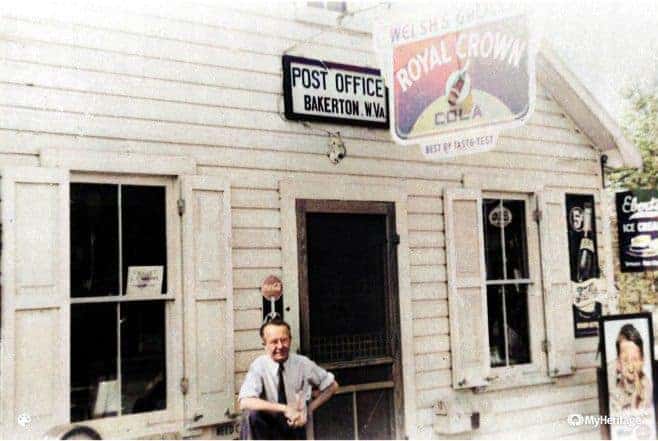
More than a place to buy bread, mail a letter, or fill a gas tank, Welsh’s Grocery was a staple of life in Bakerton. Through two generations of Welsh operation and ownership, it weathered fires, changing times, and shifting economies while remaining a constant source of service, conversation, and community connection.
The store’s porch benches, candy counter, and well-worn floors bore witness to the laughter, gossip, and everyday kindnesses that defined small-town life. In keeping the doors open and the lights on, the Welsh family preserved more than a business, but also a community. Today, as Bakerton’s only surviving store, it stands as a rare reminder of the people whose labor, generosity, and resilience shaped the working-class village of Bakerton, West Virginia.


-

- Welsh’s (The Bakerton Store). Colorized.