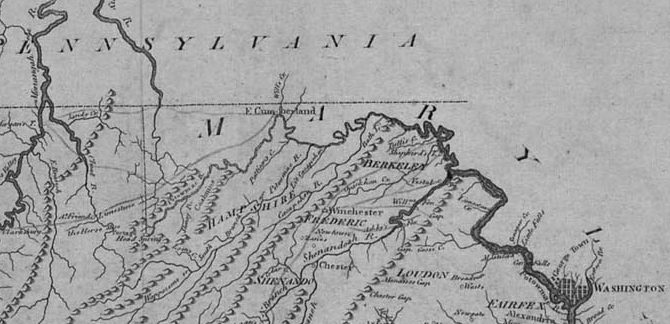
Sixteen year old George Washington surveys land in Western Virginia (now the Eastern Panhandle) for Lord Fairfax. Thomas Fairfax, the 6th Lord Fairfax of Cameron, had arrived in North America around 1736 to protect the claims to land that he had inherited from his mother's family and administered the Northern Neck Proprietary. Read more about Lord Fairfax here.

George Washington, unable to forget about the beauty of the area, purchases his first of many tracts of land in present day Jefferson County, Bullskin Plantation, located near Summit Point -- part of the lands he had just surveyed two years earlier for Lord Fairfax.

Harper, a Quaker colonist who was both a builder and a millwright, secures a patent for 125 acres in "The Hole" at the mouth of the Shenandoah River (present day Harpers Ferry), purchasing Peter Stephen's squatters rights.
Harper was on his way to construct a meeting house for fellow Quakers near present day Winchester when he first traveled through "The Hole", and was attracted to the area because of its ample water supply and strategic location. You can view the original land grant online here.

Peter Burr receives a land grant for 480 acres adjoining Captain Thomas Rutherford's property, which includes the area of present day Bardane. You can view the original land grant online here.
The home Peter Burr built on his land is now the oldest standing wood frame home in West Virginia, having been built in 1751, and has been structurally unchanged for over 200 years. For more information, visit the Peter Burr Soceity.

The meeting of the first Lodge of Free Masons to be assembled west of the Blue Ridge Mountains was held in a large limestone cave two miles south of Charles Town, and presided over by 22 year old George Washington. The cave probably became a permanent meeting place, as it was deeded to Samuel Washington, George Washington's brother, some twenty years later. A researcher currently researching the cave has put his findings online.

Established by settler Robert Harper, Harper's Ferry begins boating passengers back and forth across the Shenandoah River, making his town a starting point for settlers traveling westward. Not much information has been uncovered about ferrys used during this time period, however a model of what they probably looked like has been built and is on display at the The Prizery in South Boston, Virginia.
The governor of Virginia signs bill of incorporation for both Mecklenburg (Shepherdstown) and Romney in Hampshire County.

The town of "Shenandoah Falls at Mr. Harper's Ferry" is incorporated by the Virginia General Assembly.

General Horatio Lloyd Gates, a British soldier who served as an American General during the Revolutionary War, makes his home on 659 acres at Traveler's Rest, near Kearneysville in present day Jefferson County where he was a local justice and a lieutenant colonel in the militia. Later, in 1790, he freed his slaves and moved to New York.
Learn more about Horatio Gates, or view the National Register of Historic Places Nomination Form for Traveler's Rest.

William Little, Sr., whose son later became the first Sheriff of present day Jefferson County, built and operated grain and saw mills on the Shenandoah River at present day Millville. Little, Sr. constructed a log and clapboard home, a tenant house, and several outbuildings on the property as well. The property was passed to Sr.'s son, William Little, Jr., who sold the property to James Hite and Jacob Newcomber. It was Hite who named the property "Hopewell" after Charles Lee's home in present day Leetown. A woolen mill was later added to the property, which was operated as long as the 1920's.
Hopewell is part of the National Register of Historic Places.

The home of Samuel Washington, designed by John Ariss, was constructed in the vicinity of Charles Town. Samuel Washington was George Washington's brother.
Harewood is part of the National Register of Historic Places

Jefferson County, as it is today, is considered part of Berkeley County, Virginia.
We use this timeline to help us understand the events that may have affected or shaped a person's life. Here are some ideas as to how this timeline may help your further your own research: