

The Friday Murder Mystery
December 10, 2023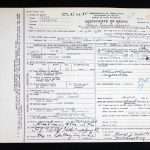
Death Certificate: Mary Howard Welsh
December 13, 2023The blockade of boats belonging to the striking canalmen has put a stop to all travel on the Chesapeake and Ohio canal. There is a squadron of about forty boats used for blockading purposes, and so effectually do they choke up the canal that no boats can pass. Saturday the flotilla was about thirty-five miles this side of Cumberland and moving slowly towards this point. There are about two hundred boats in the wake of the blockade waiting to pass up the canal. The boatmen still hold out for $1 per ton freight. They claim they are not intentionally blockading the canal, but are slowly moving along and disbanding, as many of them have to go home to look after the crops. It is understood that the president of the canal company will take legal action against the strikers if they continue to obstruct travel on the canal.
A special to the Baltimore Sun says: The blockade of the Chesapeake and Ohio canal assumed such proportions that on Saturday the sheriff of Washington county, State’s attorney and Mr. Lewis Stanhope started from Hagerstown for Hancock to break it up. It is stated that the string of canal boats extends at interval from Williamsport to within thirty of forty miles of Cumberland. The advance guard comprise thirty to forty canal boats. These constitute the so called “blockading” squadron, and move abreast, preventing any boats from passing. About 200 boats are represented to be near the blockading squadron. The names of a number of the leaders in the movement have been obtained and forwarded to Mr. Gorman, president of the canal, who has gone to the scene of the trouble. The scene of the blockade on Friday and Saturday last was between the 14 mile level and dam No. 4, forty miles below Cumberland. The blockade is to prevent boats working for less that $1 a ton for carrying coal. A letter received at Cumberland from a boatman on Friday night says: “When we left the Point of Rocks there were upwards of 175 empty boats to move. They made a bargain not to pass one another all the way to Sir John’s. As they came to their homes they dropped off till there were 21 boats when they arrived at Sir John’s, where they will remain till somebody will give them $1 per ton freights. The front boats are blamed with the blockade, but it is not so. They all say they have got enough of the present freights, and all say stop, except a few steamboats, who want to go on to Cumberland.”
A passage through the blockade was cleared yesterday by the sheriff of Washington county. A few boats went through both ways. Some crews were threatened against going back to their boats at less than one dollar. The opinion among coal men is that the blockade is not yet entirely broken.
HAGERSTOWN, July 2, 1877.– Sheriff Mayberry, of Washington county, who went to Hancock, Md., to break the blockade of the canal, reached his destination at 6 A. M. on Sunday. He summoned a posse comitatis of about a dozen men and proceeded six miles above Hancock, opposite Sir John’s run, where the trouble was the greatest. They found some seventy five or eighty boats strung along the canal and all tied up, those in front having been allowed to swing around cross-ways so as to prevent any others passing.
Many of those stopping there were willing and anxious to go on, but were prevented by those in front holding the way. The sheriff and his party were surrounded by the boatmen and a conference was held. He informed them that there was no intention of using arbitrary measures; that they were at perfect liberty to refuse to run their boats and tie up, but they could not blockade the way and prevent boats from passing and repassing, whose owners were willing to continue to run. After much talking the men finally consented to open the blockade and allow the passage of boats, but some of them swore that though they would not attempt to stop other boats from running, they would not leave their positions, and would not run until they got what they demanded, $1 per ton for freight.
One of the captains told the sheriff that while he was perfectly willing that the others should get the $1, yet even if they secured that rate, it would do him no good as he had entered into a written contract for the season to carry coal at 90 cents per ton, thus showing how the matter is complicated.
The sheriff and his party remained at the scene of the blockade until late in the afternoon, and when they left 12 or 13 boats had started through and gone on up the canal. There were also 10 or 12 loaded boats above the lock ,and although the blockade was raised it is said they were afraid to come on down the canal as they were in danger of being stoned by those in sympathy with the strikers and the strikers themselves. This can be done with little danger of the perpetrators being detected unless all the places along the canal where it runs at the foot of high bluffs were picketed with guards day and night.
The true secret of the trouble is that there are now too many boats on the canal for the freightage. The consequence has been that those who own boats and have not been able to get into any of the regular lines and thus secure freights from the coal companies have taken freights as the best price they could obtain, and in some cases have carried as low as fifty-five cents a ton, although it did not pay. Of course the raising of the blockade above Hancock does not end the trouble on the canal, and what the final result will be cannot as yet be told.
| Repository | Link |
|---|---|
| Newspapers.com | View This Record Online |
We use this timeline to help us understand the events that may have affected or shaped a person's life. Here are some ideas as to how this timeline may help your further your own research: